Cursive Alphabet
Cursive K: How to Write a Capital and Lowercase K in Cursive
Learn how to write a cursive K. Watch the capital and lowercase k drawn stroke by stroke on the writing lines, see how k joins other letters, and take the letter check.
The cursive k is built from 7 named strokes, starting with an undercurve. Watch both forms drawn on the writing lines, learn where every stroke starts and stops, and see how k joins the letters around it.
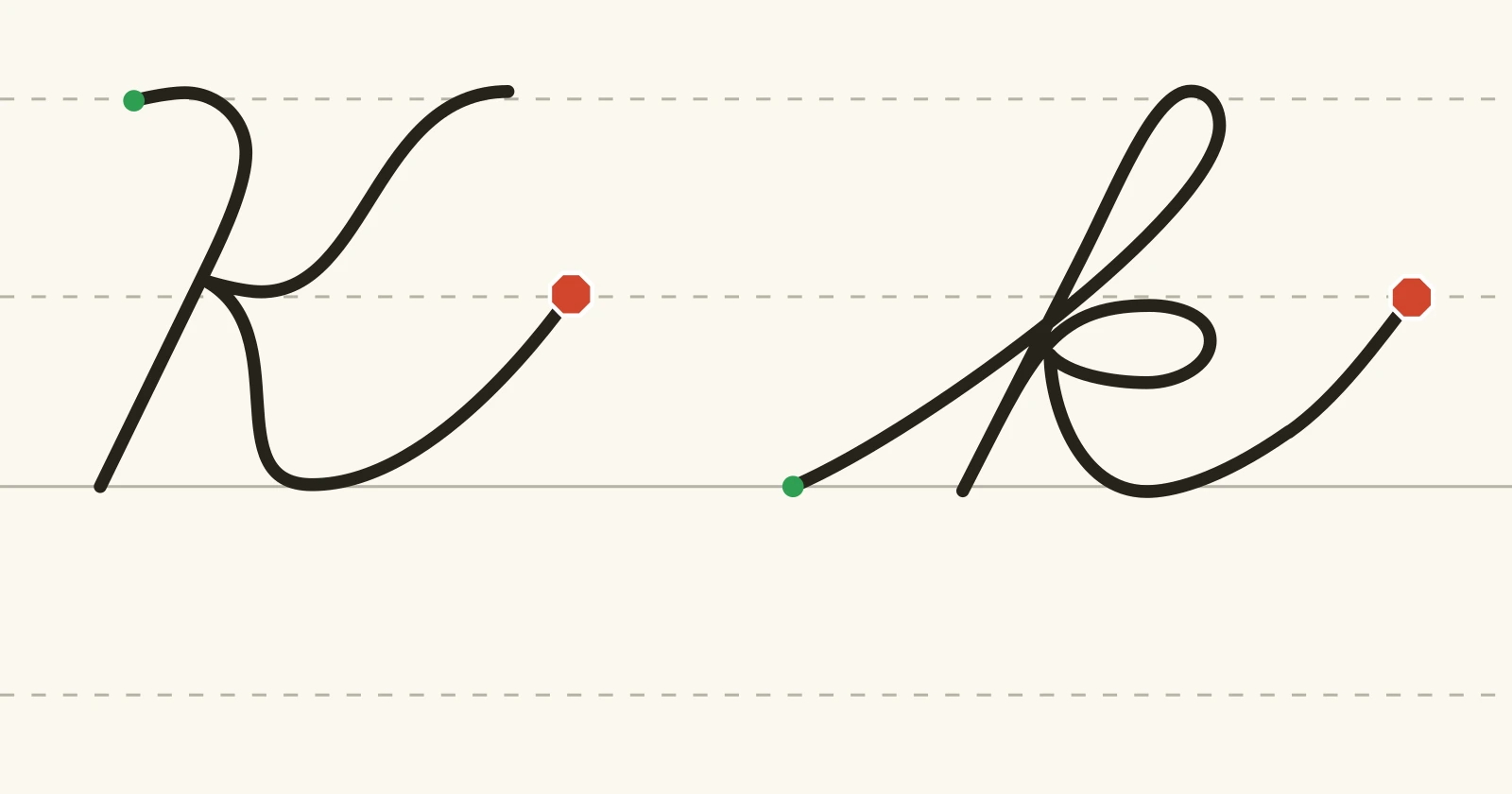
How to write a lowercase k in cursive
The model below is the exact lowercase k in cursive that children trace in Scribble. Press play to watch it drawn in one stroke on the writing lines, with a cue for every part of the stroke — then check the facts, joins, and practice words beside it.
Lowercase k has one stroke.
Lowercase k is a tall letter.
It reaches from the baseline to the topline.
- 1Make an undercurve, make a loop, slant down, curve over, make a loop, curve right, make an undercurve.Start at the baseline. Stop at the midline.
Practice, from easiest to hardest
Cursive lowercase k quiz
Take the lowercase k quiz to make sure the letter stuck: tap the two writing lines it stays between, tap where each stroke starts and stops, trace the letter with your finger or mouse, and answer the join question. Wrong taps just shake and let you try again.
4 quick checks · about a minute
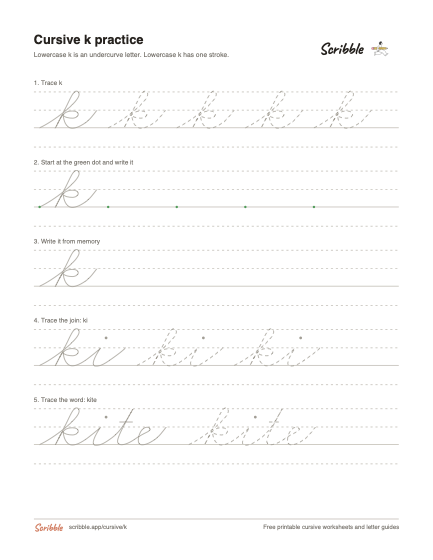
Cursive lowercase k worksheet
Print the free cursive lowercase k worksheet to move from the screen to paper. The PDF has five practice rows: trace the dashed k, write the k starting from the green dot, write it from memory, trace the join into the next letter, and trace a practice word from the Scribble curriculum.
How lowercase k joins other letters
Cursive letters slant forward and are joined together. The ending curve of the first letter can join the starting curve of the next letter — so what lowercase k does next depends only on which stroke the next letter starts with: an undercurve, a downcurve, or an overcurve.
undercurve → undercurveki
The undercurve of the k joins the undercurve of the i.
undercurve → downcurveka
The undercurve of the k joins the downcurve of the a.
undercurve → overcurvekn
The undercurve of the k joins the overcurve of the n.
How to write a capital K in cursive
The cursive capital K is written in two strokes. Press play to watch the capital K in cursive drawn on the writing lines, then note whether it connects to the letter after it — that is the habit that separates capitals from lowercase letters.
Capital K has two strokes.
First the body, then the second stroke.
K is a capital letter.
It stays between the baseline and topline.
K is a connecting capital letter.
Flow into the next letter.
- 1Curve forward, slant down.Stop at the baseline.
- 2Double curve, double curve, make an undercurve.
Practice, from easiest to hardest
Cursive capital K quiz
Take the capital K quiz to make sure the letter stuck: tap the two writing lines it stays between, tap where each stroke starts and stops, trace the letter with your finger or mouse, and answer the join question. Wrong taps just shake and let you try again.
4 quick checks · about a minute
Capital K and the next letter
K is a connecting capital letter. Flow into the next letter. In "Ki" the capital flows straight into the i without lifting the pencil.
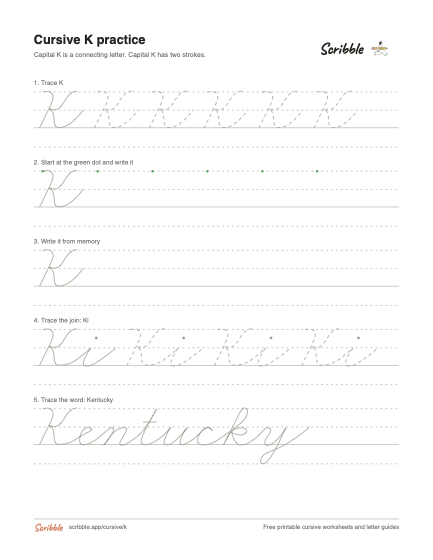
Cursive capital K worksheet
Print the free cursive capital K worksheet to move from the screen to paper. The PDF has five practice rows: trace the dashed K, write the K starting from the green dot, write it from memory, trace the join into the next letter, and trace a practice word from the Scribble curriculum.
Frequently asked questions
Practice cursive k with real feedback
Scribble teaches every letter this same way on iPad — watch, trace, write, and get feedback on shape, size, spacing, and slant.