Cursive Names
Clay in Cursive
How to write the name Clay in cursive — watch it drawn, trace every stroke, and take the free worksheet to paper.
Clay starts with the capital C, which opens on a downward slide, and the whole word takes 1 stroke without lifting the pencil. Watch it drawn stroke by stroke below, trace it on the lines, and print the free Clay worksheet when you're ready for pencil and paper.
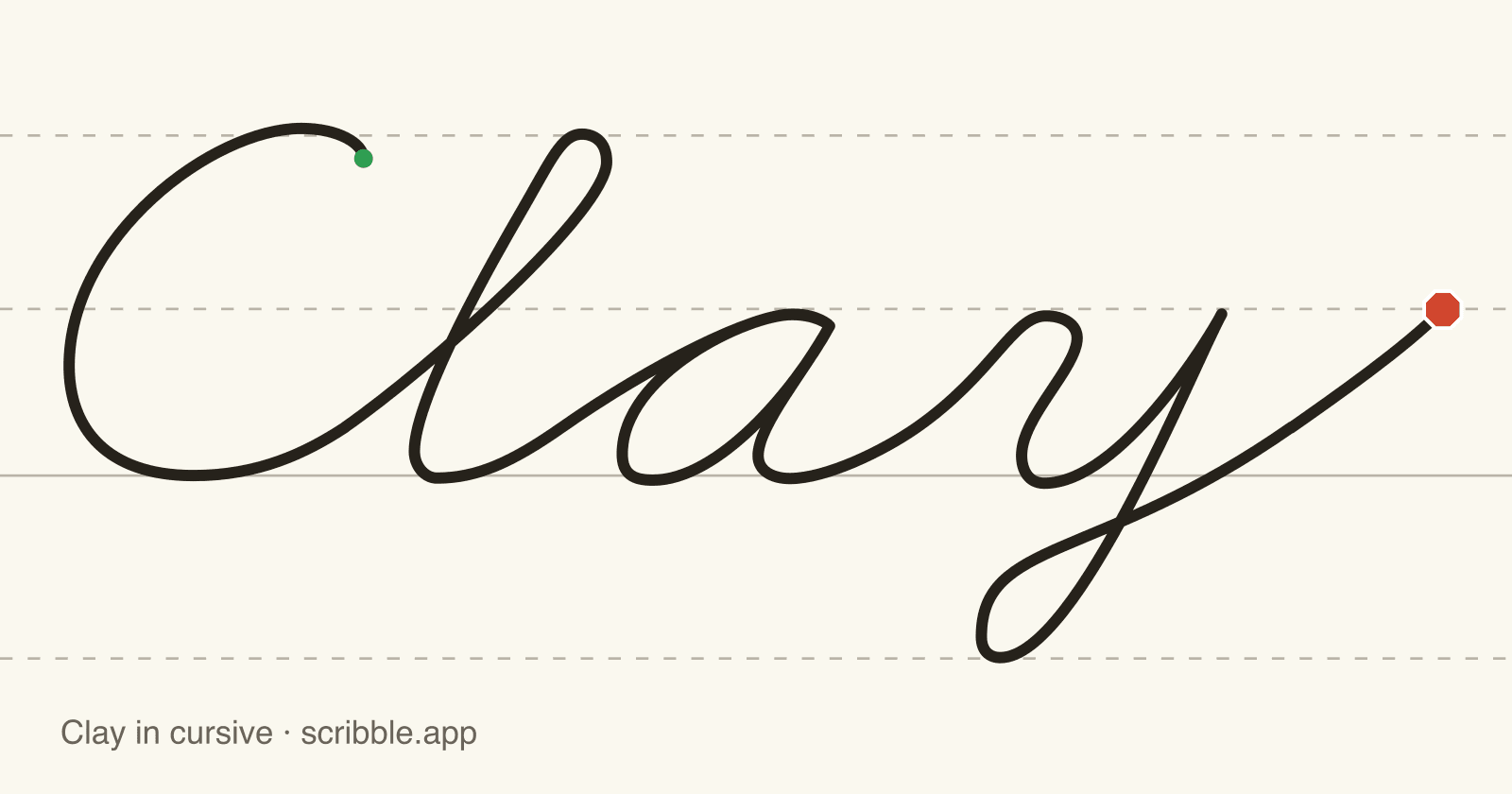
How to write Clay in cursive
- 1Keep the pencil down through C-l-a-y, letting each exit stroke become the next letter's entry.
Size is what makes Clay readable: full-height capital C, tall l, midline-height a, and below-the-line y. Uneven heights are the most common mistake, so check each letter against its lines.
How the letters in Clay connect
All 3 of the joins in Clay leave the letter on an undercurve.
The letters in Clay
Clay is only as good as its letters. Each card links to the full guide — animation, joins, quiz, and worksheet — for that letter.
Trace Clay in cursive
Ready to try? Drag from the green circle through each stroke in order. If you drift off Clay, the cursor waits for you to come back.
Put your finger or mouse on the circle and pull it through the word.
Free printable Clay cursive worksheet
Print the free Clay in cursive worksheet to move from the screen to paper: trace Clay along the dashed models, write it starting from each green dot, copy it beside the model, then fill the blank writing lines on your own.
Need a different name? Make your own name tracing worksheet — free, for any spelling.
Frequently asked questions
Practice writing Clay with real feedback
Scribble teaches cursive this same way on iPad — watch, trace, write, and get feedback on shape, size, spacing, and slant.